

A grass pellet production line is more than a group of machines placed next to each other. Each processing section performs a specific function, and the quality of the final pellet depends on how well these sections work together.
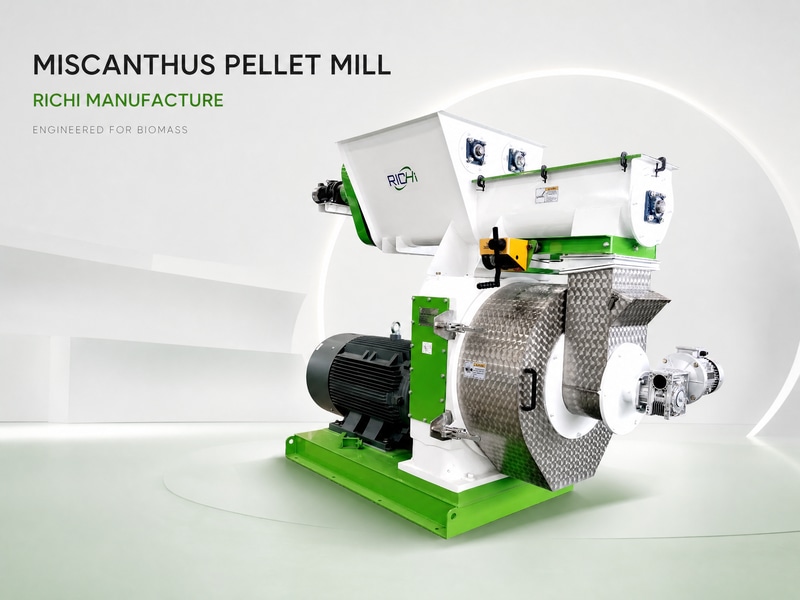
For miscanthus-based production, the miscanthus pellet mill is the central forming machine, but successful production starts well before the biomass reaches the pelleting chamber.
Raw Material Preparation
The process normally begins with harvested biomass. At this stage, the material can contain foreign matter and may have irregular dimensions.
Cleaning removes unwanted materials that could damage downstream equipment. Large stalks then need to be reduced in size to make them easier to convey, dry, and compress.
Particle size should be reasonably consistent because irregular material can affect feeding and pellet formation.
Moisture Conditioning
After crushing, the material is evaluated for moisture. If it is outside the appropriate range for stable pellet formation, drying or conditioning may be necessary.
The objective is to prepare the biomass so that the pellet mill receives material with predictable physical characteristics. This is particularly important when raw material comes from different fields or harvesting periods.
A well-designed drying section can therefore contribute to more consistent pellet production.
The Pelletizing Section
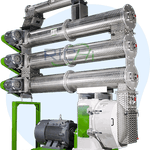
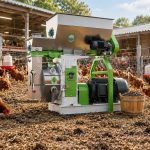
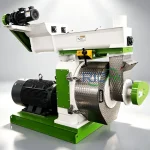
The heart of the grass pellet production line is the pelletizing machine. Prepared biomass enters the feeding system and is delivered into the compression chamber.
Pressure forces the material through the die, creating compact pellets. The exact pelletizing conditions depend on the material, moisture, particle size, die configuration, and desired product.
For fibrous biomass, stable feeding is especially important. If the material enters irregularly, the load on the pellet mill can change and pellet quality may become inconsistent.
Cooling the Finished Pellets
Pellets leave the pelletizing process at elevated temperature. They need to be cooled before they are moved into long-term storage or packaging.
Cooling helps stabilize the product and reduces the likelihood of problems during storage and transportation. After cooling, screening separates loose fines from the finished pellets.
The finished product can then be transferred to a storage area or packaging machine.
Packaging and Storage
The final packaging method depends on the market. Industrial customers may purchase pellets in bulk, while smaller customers may prefer bags.
Automatic weighing and packaging can improve consistency where retail or smaller-volume sales are important.
Storage conditions are equally important. Pellets should be protected from moisture because water can damage their physical structure and reduce their usefulness as fuel.
Why Every Section Matters
A production line can only achieve stable output when its individual sections are balanced. A high-capacity pellet mill does not solve a drying bottleneck. Similarly, an oversized dryer cannot increase output if the pelletizer is too small.
The same principle applies to conveying and cooling. Each section needs sufficient capacity to support the next stage.
This is why production-line engineering should be based on the actual raw material and target output rather than simply selecting the largest available machine.
Designing for Future Production
Some biomass businesses begin with one production line and expand after developing a stable customer base. When planning the initial factory, future expansion should be considered where practical.
Space for additional storage, conveyors, packaging systems, or another pellet mill can reduce the cost and disruption of future upgrades.
Technical documentation is useful when evaluating these possibilities. A blog here may provide general information, but project-specific engineering data is more valuable when making an investment decision.
The Role of the Main Pelletizing Machine
The pellet mill machine remains the key compression unit within the system. Its performance influences the production rate, pellet consistency, energy use, and maintenance requirements.
However, the best results come from treating the pelletizer as part of a complete process. Raw material preparation, drying, feeding, cooling, screening, storage, and packaging all contribute to commercial production.
For investors considering grass biomass as a renewable fuel resource, understanding this complete flow makes equipment selection much easier. Instead of buying individual machines independently, they can evaluate how the entire production line should work as one coordinated system.
view details: https://www.richimanufacture.com/miscanthus-pellet-mill/