
Can Waste Paper Become a Valuable Product for the Pet Care Industry?
Waste paper is often treated as a low-value recycling material, but its potential extends well beyond conventional paper recovery. With suitable processing, selected paper fibers can become absorbent granules for pet litter, offering recyclers, entrepreneurs, and pet product manufacturers another way to utilize recovered resources.
The opportunity is particularly interesting for businesses that already collect cardboard, office paper, or other recyclable paper products. Instead of selling every recovered material into the same recycling channel, operators may investigate whether part of their available feedstock can support a specialized product line.
However, transforming discarded paper into commercial cat litter requires more than pressing paper into small pieces. Raw material preparation, moisture management, granule formation, drying, screening, and packaging all influence the final product.
A well-planned production process begins with the intended market rather than the machine itself. Understanding what customers expect from paper cat litter helps manufacturers select an appropriate process and establish realistic quality standards.
Understanding the Raw Materials Behind Paper Cat Litter
Not all waste paper behaves in the same way during processing. Different grades vary in fiber length, absorbency, coating content, ink residues, moisture, and contamination.
Clean cardboard and selected uncoated paper grades may provide useful fibrous feedstock. Shredded paper can also be considered when its composition and cleanliness are suitable for the intended application. Conversely, heavily coated paper, laminated packaging, thermal paper, and materials containing unsuitable chemicals may require exclusion.
A preliminary raw material assessment should examine several characteristics.
First, manufacturers need to understand the consistency of their supply. A recycling business receiving similar paper grades every day may find it easier to maintain a stable product than a facility processing unpredictable mixed waste.
Second, contaminants must be identified. Plastics, metal fragments, adhesive residues, and unsuitable chemical coatings can affect equipment operation and the suitability of the finished litter.
Third, particle size matters. Large cardboard pieces cannot be fed directly into every pelletizing system. Shredding and grinding may be required to produce a more uniform material.
Finally, moisture content should be measured. Material that is excessively wet may require drying or mechanical dewatering, while very dry fibers may need controlled moisture conditioning to improve processing behavior.
The best preparation method depends on the paper grade, the desired granule characteristics, and the equipment configuration.
From Collection to Finished Granules: A Practical Production Workflow
A paper cat litter facility usually combines several processing stages. Their exact arrangement depends on whether the manufacturer begins with clean paper fibers, shredded cardboard, or a more complex recovered-paper stream.
1. Sorting and contaminant removal
Incoming paper is inspected and separated according to material quality. Magnets, manual sorting stations, screens, or other separation equipment may be appropriate depending on the feedstock.
This stage reduces the risk of foreign materials entering downstream equipment. It also helps manufacturers separate suitable fibers from grades that require different recycling routes.
2. Shredding and size reduction
Large sheets, cartons, and cardboard pieces must be reduced to a manageable size. A shredder or crusher prepares the material for subsequent grinding and conditioning.
The required particle size should be determined through process testing. Extremely coarse material may form inconsistent granules, while unnecessary overgrinding can increase energy consumption and create excessive fines.
3. Fiber preparation and conditioning
Depending on the selected raw material, the process may include further grinding, moisture adjustment, or mixing.
Some paper-based products can be processed using dry fiber preparation and controlled conditioning. Other formulations may require additional treatment to achieve the desired bonding behavior.
Water addition should never be based on guesswork alone. Excess moisture can increase drying requirements and may cause unstable pellet formation, whereas insufficient conditioning can lead to weak granules.
4. Pellet formation
The prepared material enters a suitable pelletizing system, where pressure and the selected die configuration help form granules.
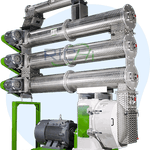
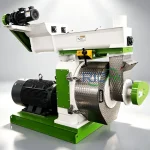
For manufacturers evaluating a paper pellet machine, the important question is not simply whether the equipment can produce pellets. It is whether the resulting granules meet the intended specifications for diameter, length, strength, bulk density, and absorbency.
Paper fibers differ from wood particles and agricultural biomass. Therefore, equipment selection should be supported by trials using the actual feedstock rather than assumptions based solely on nominal capacity.
5. Drying and cooling
Freshly formed granules may contain more moisture than the finished product can tolerate during storage. Depending on the process, a dryer may be needed to achieve a stable moisture level.
Drying conditions should be selected to avoid damaging the granules or creating unnecessary dust. After drying, cooling allows the product to approach a suitable packaging temperature.
6. Screening and packaging
Screens separate acceptable granules from undersized fines and oversized particles. Depending on the production objective, some rejected fractions may be returned to an appropriate upstream stage.
The finished litter is then packed in bags or larger commercial packages. Packaging must protect the product against moisture absorption and contamination during storage and transportation.
What Makes Paper Cat Litter Suitable for Its Intended Market?
Pet owners do not evaluate litter solely by appearance. They care about how it performs during everyday use, how easily it can be handled, and whether it meets their expectations for cleanliness.
Absorbency is one important characteristic. The paper structure and processing conditions influence how quickly moisture enters the granule and how much liquid it can retain.
Granule integrity is equally relevant. If pellets break down too easily during transport or handling, the package may contain excessive dust and fines. If the product is too hard or dense, its absorption behavior may differ from what the intended customer expects.
(Related Post: https://biomasspelletizer.com/paper-cat-litter-making-machine/ )
Particle dimensions also influence usability. Smaller granules and larger pellets can provide different handling experiences, so the appropriate size should be established through customer research and product testing.
Odor management requires particular care. Paper cat litter does not automatically provide strong odor control simply because it is absorbent. Performance depends on the formulation, moisture behavior, cleanliness, and any permitted additives used in the product.
Manufacturers should also evaluate dust generation, storage stability, packaging durability, and the suitability of the material for its stated disposal method.
Claims about flushing, composting, biodegradability, or environmental benefits should be supported by appropriate testing and local requirements. A product made from recycled paper is not automatically suitable for every disposal system.
How Should Manufacturers Choose Production Capacity?
Capacity planning should begin with the actual volume of suitable raw material available, rather than the maximum output advertised for a machine.
A recycling company processing a few hundred kilograms of usable paper per hour has different requirements from an established manufacturer supplying several retail markets.
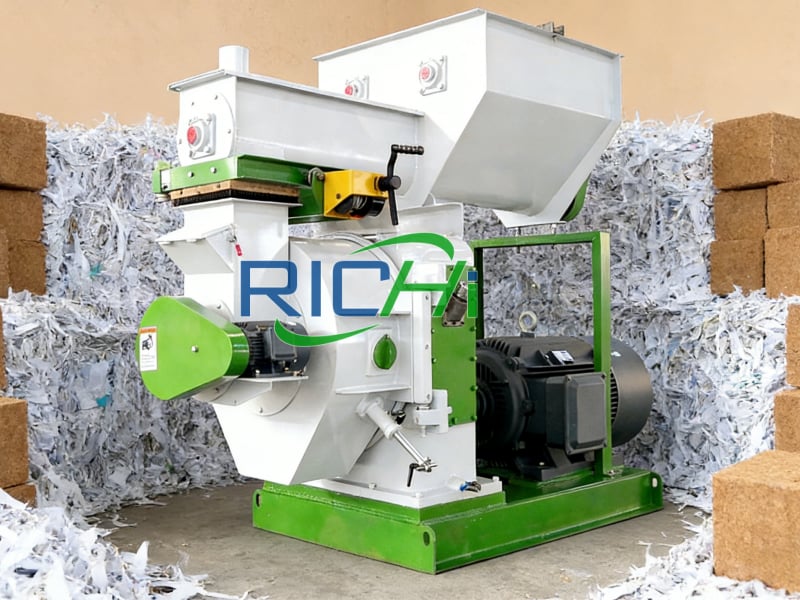
For a small operation, a 0.2-0.5T/H Paper Cat Litter Making Machine for sale may be worth evaluating when the available feedstock and expected sales volume are limited. The nominal capacity should still be verified against the specific paper formulation, operating conditions, and acceptable finished-product quality.
A larger operation may require additional preparation equipment, more drying capacity, automated conveying, and a packaging system capable of handling the output.
The production line must be balanced across all stages. If pellet formation is faster than drying, material may accumulate between processes. If the packaging system cannot keep up, finished litter can become a bottleneck even when the pelletizing equipment performs well.
Manufacturers should also account for operating shifts, planned maintenance, material changes, product rejection, and cleaning time. Theoretical hourly output is not the same as saleable daily production.
Calculating Whether the Project Makes Commercial Sense
A realistic feasibility study considers both incoming material costs and the value of the finished product.
The feedstock may be inexpensive, but collection, sorting, transportation, preparation, electricity, labor, drying, packaging, and waste handling can create substantial expenses.
A useful starting point is to calculate the total cost per tonne of saleable litter rather than the cost per tonne of incoming paper.
For example, if a facility receives one tonne of mixed paper but only part of it meets the required quality standards, the usable output must be calculated after rejecting unsuitable material and accounting for moisture changes.
The manufacturer should then estimate the quantity of finished litter that can be produced from each tonne of accepted feedstock. This conversion rate should be established through trials, not assumed to be identical for every paper grade.
Market research is another essential part of the calculation. Retailers may require consistent granule sizes, private-label packaging, reliable delivery schedules, and documentation for product claims.
A technically successful process is only the first step. Sustainable commercial performance also depends on repeat purchases, distribution costs, and a product that meets customer expectations.
Designing a Reliable Production Line
A complete facility should be designed around the material’s physical properties and the intended product.
A basic layout may include a receiving area, sorting equipment, shredding and grinding machinery, a conditioning section, pelletizing equipment, drying and cooling systems, screening, and packaging.
Dust collection and ventilation deserve attention throughout the layout. Paper dust can accumulate around transfer points, while moving equipment introduces mechanical hazards. A suitable dust-control strategy, appropriate electrical protection, housekeeping procedures, and a documented fire-risk assessment should form part of the engineering design.
Maintenance access is equally important. Operators need room to inspect motors, replace worn components, clean material pathways, and remove blockages without creating unsafe working conditions.
Before committing to a full installation, manufacturers should request a process review based on representative feedstock samples. This can help determine whether additional preparation or a different pelletizing arrangement is needed.
Industry suppliers such as Richi Machinery can be included in the equipment comparison process when a project requires machinery selection, capacity assessment, or a coordinated production layout. Final specifications should be confirmed against the actual material and the manufacturer’s documented performance data.
Questions to Resolve Before Purchasing Equipment
A useful equipment inquiry should provide more information than a target production rate.
Manufacturers should identify the paper grades they intend to process, the expected incoming moisture, the desired granule diameter and length, the target finished moisture, and the required packaging format.
They should also clarify whether the finished product is intended for direct retail sale, bulk distribution, or further processing.
A supplier should be asked to explain which stages are included in the proposed scope, what utilities are required, and which performance figures are guaranteed under specified conditions.
If absorbency, dust generation, or granule durability is central to the product concept, representative sample testing is especially valuable.
The final purchase decision should compare the complete operating solution, not just the initial equipment price.
Conclusion
Waste paper can offer an alternative feedstock for manufacturers exploring the pet care market, but commercial success depends on consistent raw materials, suitable processing technology, and reliable finished-product performance.
A carefully designed production line connects recycling operations with a practical consumer product while reducing avoidable processing problems. By evaluating feedstock quality, process balance, capacity, operating costs, and market requirements before purchasing equipment, businesses can make better-informed investment decisions.
The most useful next step is to test the intended paper material, establish measurable product specifications, and develop a process plan that connects actual production conditions with realistic market demand.
For further technical comparison and equipment research, readers can view website resources from machinery suppliers and recycling-industry publications before deciding which configuration best fits their project.