
For poultry farms, egg producers, livestock operations, and fertilizer manufacturers, manure is often treated as an unavoidable waste stream. Yet poultry manure contains organic matter and plant nutrients that can be recovered and converted into a useful fertilizer product. The difference between disposal and resource recovery depends largely on how the material is handled, conditioned, dried, pelletized, and stored.
Modern manure pellet production is no longer simply about pressing waste into small cylinders. A practical system must consider moisture, fiber content, particle size, odor control, material flow, pellet durability, cooling, screening, and packaging. When these factors are managed properly, manure can be transformed from a difficult material into a standardized agricultural input.
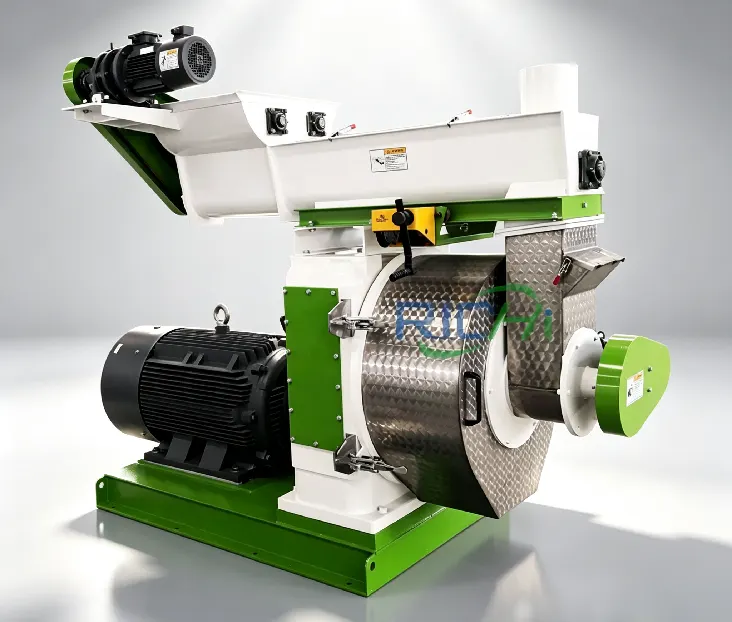
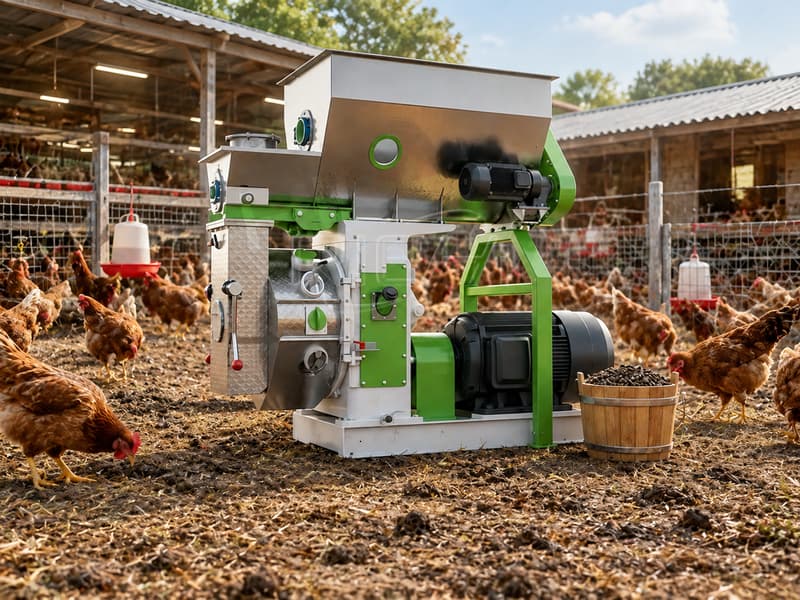
A well-designed chicken manure pellet machine can be part of this transformation, but the pelletizer itself is only one component of a complete production concept. Understanding what happens before and after pelletizing is essential for anyone considering a commercial manure fertilizer project.
Why Poultry Manure Is Different from Conventional Fertilizer Raw Materials
Poultry manure is biologically active and highly variable. The material collected from a poultry house may contain bedding, feathers, feed residue, moisture, and foreign particles. Its condition can also change depending on storage time, climate, collection method, and farm management practices.
This means a fertilizer plant cannot simply receive wet manure and send it directly into a pelletizing chamber.
Fresh manure typically contains too much moisture for stable mechanical forming. Extremely wet material can cause feeding problems, poor compression, unstable production, and blockages. On the other hand, material that becomes excessively dry or contains too much coarse fiber may require additional conditioning before it can form consistent pellets.
The first step is therefore not pelletizing. It is understanding the raw material.
For a commercial project, operators normally examine moisture, particle size, contamination level, organic composition, and expected daily throughput. These factors influence equipment selection more than a generic machine capacity figure.
From Farm Collection to Usable Feedstock
A successful manure fertilizer project begins with collection and preparation.
After manure is collected, larger foreign materials need to be removed. Depending on the farm and raw material condition, this stage may involve conveying, magnetic separation, screening, crushing, or other cleaning methods.
Particle size is another important consideration. Large fibers or compacted lumps can reduce the stability of the downstream process. A crusher or grinder may be introduced when a more uniform feedstock is required.
The goal is not to make the material into powder. Instead, the objective is to create a reasonably consistent structure that can move through the drying, mixing, and pelletizing sections without major fluctuations.
This preparation stage becomes particularly important when manure is mixed with other organic materials. Poultry litter can be combined with crop residues, composted materials, mineral additives, or other agricultural by-products depending on the intended fertilizer formulation.
Moisture Determines More Than Pellet Quality
Moisture is one of the most underestimated variables in organic fertilizer pellet production.
When the material contains too much water, it may behave more like a sticky mass than a compressible feedstock. Drying then becomes necessary before pelletizing. When the material is too dry, however, it can become difficult to compact consistently and may generate excessive powder.
The ideal operating condition is not universal. Different formulations require different preparation strategies.
This is why commercial producers should avoid choosing a dryer purely by name or nominal capacity. The actual material moisture before drying, target moisture after drying, air temperature, residence time, and heat source all matter.
For larger projects, the drying system may become one of the most significant sections of the entire plant because it directly influences energy consumption, production continuity, and downstream pellet quality.
Why Pelletizing Changes the Business Model
Loose manure is difficult to handle. It can be dusty, bulky, inconsistent, and inconvenient to transport. Pellets provide a more standardized physical form.
With a suitable 1-2T/H Cow Manure Fertilizer Pellet Machine, for example, a relatively small fertilizer project can be structured around manageable production volumes rather than immediately investing in a very large industrial system.
Pelletizing offers several practical benefits.
The first is material density. Pellets generally occupy less bulk volume than loose organic material, making handling and storage more organized.
The second is uniformity. Granulated material can be easier to meter, bag, transport, and apply compared with irregular manure.
The third is product positioning. A bagged organic fertilizer pellet can be presented as a finished agricultural product rather than as untreated farm waste.
That change in physical form can make a major difference to distribution.
Pellet Size Should Follow the End Use
Not every fertilizer producer should make the same pellet size.
Some products are intended for agricultural field application, while others are sold through garden centers, landscaping businesses, crop farms, or specialty fertilizer distributors. Packaging sizes may also vary from bulk bags to smaller retail units.
Because application methods differ, pellet dimensions should be selected according to the target market and spreading equipment.
A uniform pellet is generally more useful than a pellet that varies widely in diameter and density. Operators therefore need to think about the relationship between die specifications, raw-material preparation, moisture, and machine settings.
Instead of asking only, “What pellet diameter can the machine produce?”, a better question is, “What physical characteristics does the final customer actually need?”
What Happens After Pelletizing?
Pelletizing is not the last step.
Fresh organic fertilizer pellets often leave the pelletizing section with elevated temperature and residual moisture. They normally require cooling and stabilization before screening and packaging.
Cooling is important because warm pellets can accumulate condensation after entering storage bags. If moisture becomes trapped inside packaging, product stability can decline.
Screening is also useful because a commercial fertilizer product typically needs to separate fines and oversize material. Recovered fines can often be returned to the process instead of being discarded.
The final stage is packaging.
Depending on the target market, fertilizer may be packed in small retail bags, medium agricultural sacks, or larger bulk packaging. Packaging should protect the pellets from moisture while also presenting clear product information.
Energy Planning Should Start Early
Many manure pellet projects focus heavily on the pelletizer and overlook energy demand from drying.
This can create an inaccurate project budget.
If raw manure enters the system with high moisture, a substantial portion of the production cost may come from moisture removal rather than pellet formation. Therefore, fuel availability, waste-heat recovery, biomass fuel options, and dryer efficiency should be considered during the planning stage.
A producer with access to low-cost biomass residues may have a different operating model from a producer relying on purchased fossil fuels.
Likewise, a farm with seasonal manure availability may require buffer storage, while a fertilizer factory with multiple suppliers may need a continuous receiving system.
The pellet machine should fit the raw-material reality, not the other way around.
Can Small Farms Start with a Compact System?
They can, depending on the material and business model.
Smaller agricultural businesses often have an advantage that large industrial plants do not: they may already have access to the raw material at low or negligible acquisition cost.
A modest system can therefore focus on local fertilizer demand rather than national distribution.
The key is to match production volume with realistic sales channels. Building a huge facility before validating local market demand can create unnecessary financial pressure.
For smaller operations, equipment layout, labor requirements, easy cleaning, raw-material storage, and simple maintenance can be just as important as maximum throughput.
When Does a Manure Pellet Project Make Sense?
There is no single business model.
A poultry farm may use the pellets internally, reducing dependence on purchased soil amendments.
A fertilizer company may buy manure from multiple farms and sell a branded organic fertilizer product.
A feed or biomass machinery company may integrate fertilizer equipment as an additional production line.
A farming cooperative may process manure collectively and distribute finished fertilizer among members.
The right configuration depends on who controls the raw material, who buys the final product, and how much material is available throughout the year.
(Related Post:https://www.richipelletmill.com/organic-fertilizer-pellet-machine/)
That is why project planning should begin with three practical questions: What manure is available? What product will be sold? Where will that product go?
Where Equipment Selection Fits into the Bigger Picture
Machinery should support the process instead of defining it.
An equipment supplier with experience in organic fertilizer systems can help connect raw-material preparation, drying, mixing, pelletizing, cooling, screening, and packing into a coherent workflow. This approach is particularly useful for producers who are moving from farm-scale waste management into commercial fertilizer production.
When evaluating suppliers, it is also useful to look beyond the pelletizer itself. Consider the proposed process flow, capacity assumptions, moisture calculations, electrical requirements, spare parts, installation support, and commissioning plan.
Technical details become much easier to evaluate once the actual production scenario is clearly defined.
For additional technical reading on fertilizer machinery and production concepts, from this source readers can continue exploring related processing topics and equipment applications.
From Waste Handling to Circular Agriculture
The most interesting part of manure pelletizing is not the machine itself. It is the change in mindset.
Instead of viewing manure as a disposal problem, producers can treat it as an agricultural resource. Instead of moving untreated waste from one place to another, they can create a standardized product with more predictable handling characteristics.
The broader value comes from connecting livestock production and crop production into a more circular system.
The poultry operation generates organic nutrients. The processing system stabilizes and standardizes them. The fertilizer reaches farms, gardens, or landscaping applications. Nutrients return to the soil, and the cycle continues.
For many agricultural businesses, that is the real opportunity behind manure pellet production.
The question is no longer simply how to manage poultry waste. It is how to turn an inconsistent material into a product that customers can store, transport, measure, and use with confidence.
That is where thoughtful process design makes the difference.